
Table of Contents
ToggleReading and literacy development are terms people often use interchangeably. They shouldn’t. While both concepts connect to language learning, they describe different skill sets and growth processes. Understanding the distinction between reading development and literacy development matters for educators, parents, and anyone invested in language education. This article breaks down what separates these two concepts, how they overlap, and why recognizing their differences leads to better learning outcomes.
Key Takeaways
- Reading development focuses specifically on decoding written text, while literacy development encompasses reading, writing, speaking, listening, and critical thinking skills.
- Reading development follows predictable stages with foundational skills typically set by age 10, whereas literacy development continues throughout life with no defined endpoint.
- Strong reading and literacy development support each other—frequent reading expands vocabulary, and writing practice helps readers understand text structures.
- Literacy development includes critical literacy skills like evaluating sources, identifying bias, and understanding how language shapes thinking.
- Educators achieve the best outcomes when addressing reading and literacy development together through integrated approaches rather than isolated instruction.
- Early language exposure between ages 3 and 8 is critical for reading development, giving children who hear rich language at home a significant advantage.
Understanding Reading Development
Reading development refers to the process of learning to decode written text. It starts with basic skills like letter recognition and phonemic awareness. Children learn to connect sounds to symbols. They progress from sounding out individual letters to recognizing whole words.
The stages of reading development follow a predictable pattern. First, children become aware that print carries meaning. They notice signs, labels, and books around them. Next comes phonics instruction, where learners connect letters to sounds. This skill allows them to decode unfamiliar words.
Fluency develops as readers practice. They move from slow, word-by-word reading to smooth, expressive delivery. Speed increases. Comprehension improves because less mental energy goes toward decoding.
Reading development also includes vocabulary expansion and comprehension strategies. Readers learn to make predictions, ask questions, and summarize what they’ve read. They build mental models of texts. They connect new information to prior knowledge.
Research shows that reading development depends heavily on early exposure. Children who hear rich language at home enter school with advantages. They recognize more words. They understand sentence structures better. Reading development continues through adulthood, though the most critical window occurs between ages 3 and 8.
What Is Literacy Development
Literacy development encompasses a broader range of skills than reading alone. It includes reading, writing, speaking, listening, and critical thinking. Literacy development describes how people learn to communicate effectively across multiple formats.
A literate person doesn’t just decode text. They interpret meaning, evaluate sources, and create their own communications. Literacy development builds these interconnected abilities over time.
Writing skills form a core component of literacy development. Learners progress from scribbling to forming letters to composing sentences. They learn grammar rules, punctuation conventions, and text organization. Writing reinforces reading skills and vice versa.
Speaking and listening contribute to literacy development too. Oral language provides the foundation for written language. Children who develop strong speaking skills often become better readers and writers. They have larger vocabularies. They understand how stories work.
Critical literacy adds another dimension. It teaches learners to question texts, identify bias, and understand how language shapes thinking. Modern literacy development includes digital skills. People must evaluate online sources, understand media formats, and communicate across platforms.
Literacy development continues throughout life. Adults improve their literacy through education, reading, and professional development. Unlike reading development, which has clear early stages, literacy development remains open-ended.
Core Differences Between Reading and Literacy
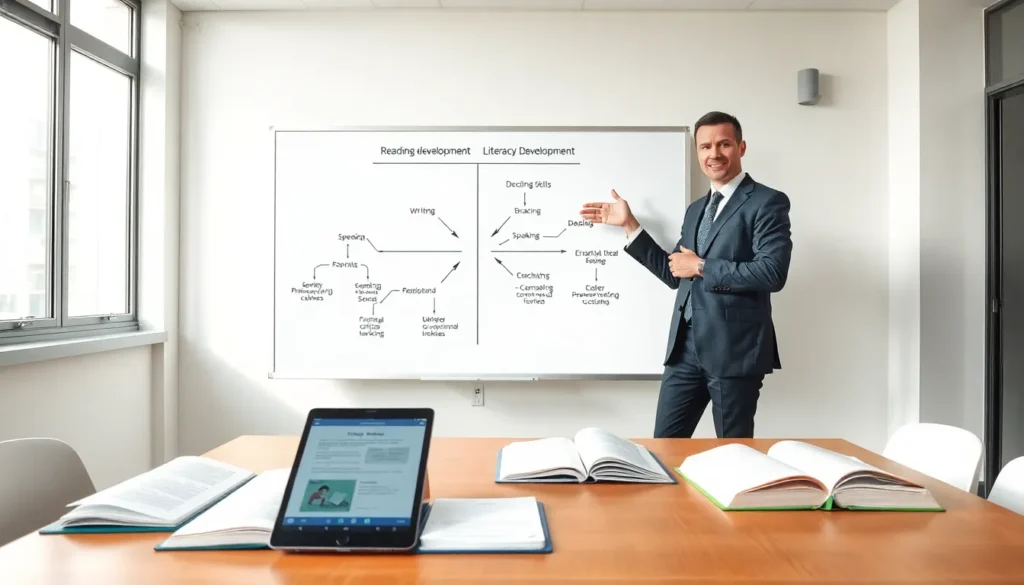
The distinction between reading and literacy comes down to scope. Reading development focuses on one specific skill: decoding written text. Literacy development includes reading plus multiple other communication abilities.
Think of it this way: all readers develop some literacy, but literacy development goes beyond what reading alone provides. A person can decode words fluently without having strong literacy skills. They might struggle to write clearly, evaluate sources critically, or express ideas verbally.
Scope and Focus
Reading development concentrates on print. Learners master letter-sound relationships, build sight word recognition, and develop comprehension strategies specific to written text. The goal is fluent, meaningful reading.
Literacy development spreads across communication modes. It includes print literacy but adds oral communication, visual literacy, and digital skills. The goal is effective communication in all forms.
Timeline and Progression
Reading development follows defined stages. Most children learn to read between ages 5 and 7. By age 10, most have achieved reading fluency. Development continues, but the foundational skills are set.
Literacy development has no endpoint. A person’s literacy grows with each new genre they master, each writing skill they acquire, and each communication challenge they face. Adults can significantly improve their literacy throughout life.
Measurement
Reading development is easier to measure. Tests assess decoding speed, accuracy, and comprehension. Progress is visible and quantifiable.
Literacy development is harder to assess. It involves subjective judgments about writing quality, speaking effectiveness, and critical thinking depth. No single test captures the full picture.
How Reading and Literacy Skills Work Together
Reading and literacy development support each other in important ways. Strong reading skills accelerate literacy development. Broad literacy supports better reading outcomes.
Children who read frequently expand their vocabularies. Larger vocabularies improve both reading comprehension and writing quality. The connection works both ways. Writing practice helps readers notice text structures. It builds awareness of how authors make choices.
Oral language skills provide a foundation for both reading and literacy development. Children learn spoken language first. They bring this knowledge to reading instruction. Strong speakers often become strong readers because they already understand how language works.
Critical thinking connects reading and broader literacy too. Readers who question texts become better evaluators of all information sources. They apply the same analytical skills to videos, speeches, and conversations.
Educators see the best outcomes when they address reading and literacy development together. Isolated phonics instruction helps children decode, but it doesn’t build full literacy. Writing instruction reinforces reading skills. Discussion activities strengthen oral language while supporting comprehension.
Research on reading and literacy development shows that integrated approaches produce stronger learners. Students who write about what they read understand texts better. Students who discuss ideas develop clearer thinking. Reading development matters, but it works best within a broader literacy framework.


